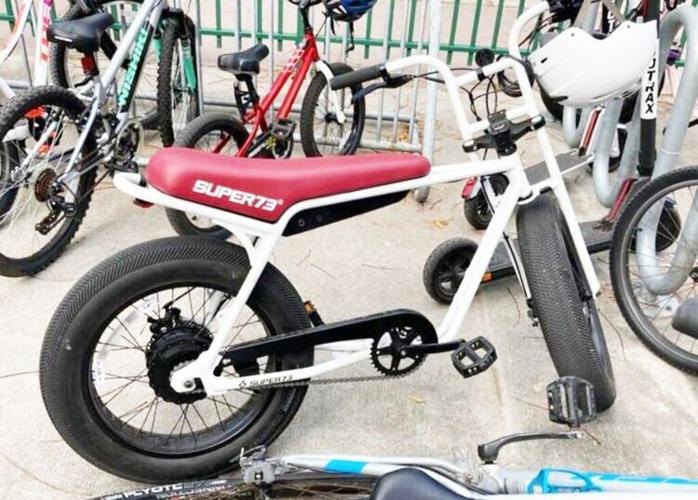
Key Biscayne police will keep writing tickets for e-bike and scooter violations on Crandon Boulevard for at least two more years after Miami-Dade commissioners unanimously renewed the Village's enforcement agreement on Thursday, July 23, according to the Key Biscayne Portal.
The interlocal agreement extends through July 31, 2028, and covers Crandon Boulevard from the Village's northern boundary to the northern entrance of Bill Baggs Cape Florida State Park. Under its terms, only Class-1 e-bikes and motorized scooters are permitted in the bike lane. All other micromobility devices remain banned within Village limits.
Riders who break the rules face a $250 fine for a first offense and $500 for each subsequent violation.
Key Biscayne Police Chief Frank Sousa said he was pleased the agreement passed and that the renewal keeps enforcement regulations in place. "We work at the will of the Council," Sousa told the Key Biscayne Portal. "Our elected officials have made it clear they continue to support the ban."
The original enforcement framework, sponsored by Commissioner Raquel Regalado, was adopted on Monday, May 27, 2024, with a built-in two-year sunset clause. It followed the death of Megan Andrews, 66, who was struck and killed on Wednesday, Feb. 14, 2024, by a 12-year-old riding an e-bike on Key Biscayne. A second fatal crash occurred on Friday, Aug. 15, 2025, when Fabian Moses, 54, was killed on the Rickenbacker Causeway by a 14-year-old on an e-bike. The teen was arrested and charged.
Regalado noted the local framework serves as a placeholder after the Governor vetoed a state-level micromobility bill, and that the Village held more than a dozen public meetings before the original agreement was finalized.
New 20 mph cap on the Rickenbacker
At the same July 23 meeting, commissioners unanimously approved a separate ordinance capping e-bikes and motorized scooters at 20 mph on the Rickenbacker Causeway. The measure also bans micromobility devices from sidewalks (except for designated parking), requires riders to stay in bike lanes or on streets with a posted speed limit of 30 mph or less, and mandates a 3-foot clearance when parking devices near walkways.
Like the original ordinance, the new rule carries a two-year sunset and will need renewal or replacement before it expires.
Expansion to other cities tabled
Commissioner Micky Steinberg proposed letting Miami-Dade's 33 other incorporated municipalities opt into the same enforcement framework, calling Key Biscayne's approach "a model for what they should be doing."
Regalado tabled the idea, explaining that each city would need its own public meetings, dedicated regulations, and tailored fines and speed limits.
"I am happy to draft an ordinance for cities to opt in, but it needs to have a lot of things that are not in this ordinance because this ordinance came after two years of working with Key Biscayne," Regalado said at the July 23 meeting.
Commissioner Vicki Lopez noted that she authored state legislation while serving in the Florida Legislature that allows local governments to regulate micromobility devices, and that Miami Beach is looking to expand that statute in the coming legislative session.
No timeline has been announced for the proposed opt-in ordinance. Enforcement on Crandon Boulevard continues without interruption through July 31, 2028.