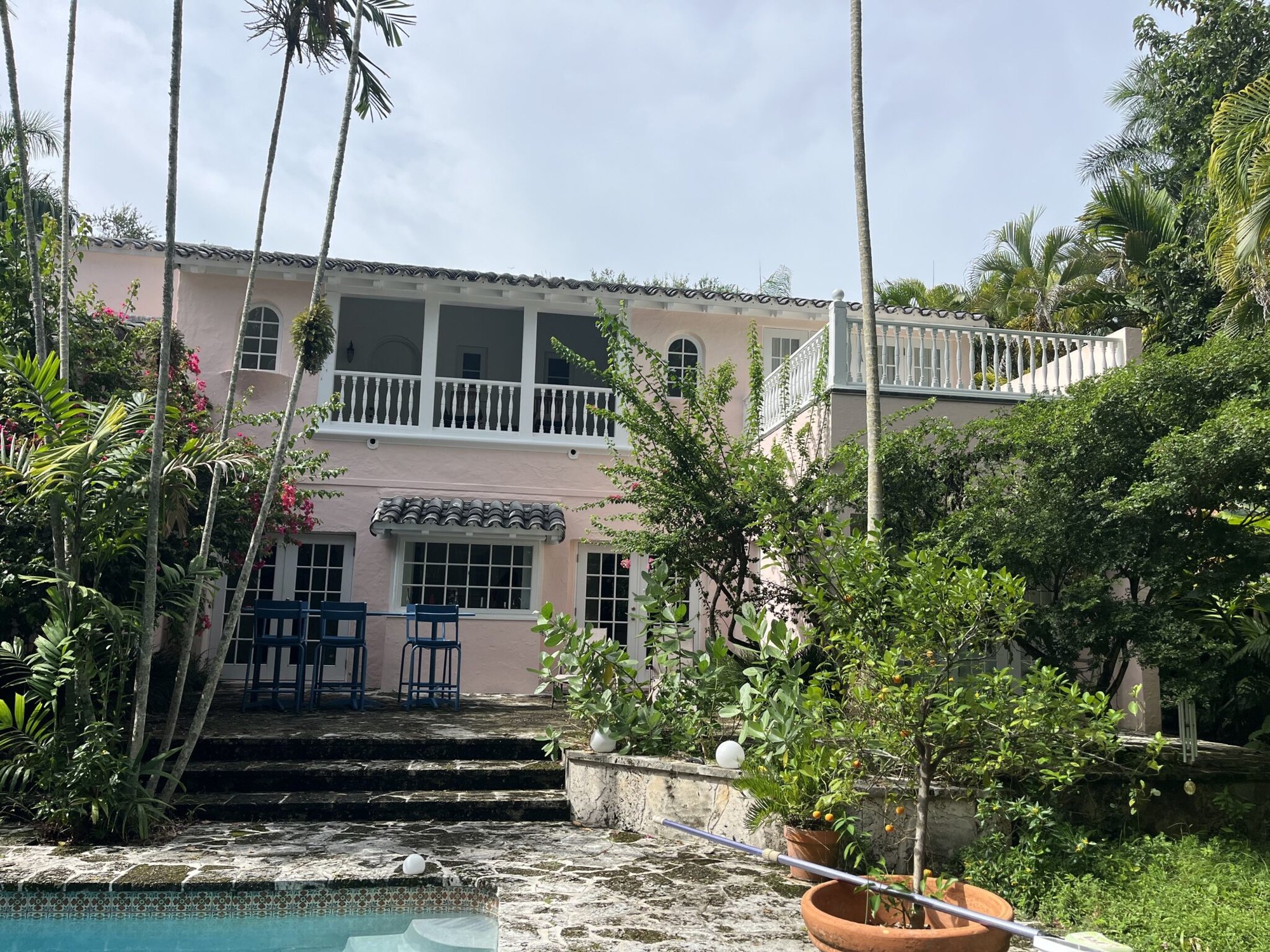
A coral-pink stucco house on Braganza Avenue could become one of Coconut Grove's newest historically designated properties, shielding it from the demolitions that residents say have erased older homes across the South Grove.
Barbara Lange, a 15-year resident who walks her sheepdog Chumley past the empty lots where older homes once stood, applied to the City of Miami for historic designation of her two-story home at 3901 Braganza Ave. The house was built in 1925 in a blend of Masonry Vernacular, Mediterranean Revival and Mission Revival styles.
On Tuesday, July 7, Miami's Historic and Environmental Preservation Board unanimously approved a preliminary evaluation of Lange's application. A city staff report identified numerous historic features, including the tiled roof, arched openings, balconies and twisted columns, and cited substantial evidence the home was designed by Walter DeGarmo, the first registered architect in the Miami area. Historical records describe DeGarmo as the "Dean of Miami architects."
DeGarmo moved to Coconut Grove in 1903 and designed more than 30 homes throughout the area.
"When I'm dead and gone, I just would like it to stay," Lange told the Coconut Grove Spotlight. "I'd like the old part of the house to be the same."
The application comes as single-family home prices in Coconut Grove climbed 205.8% between 2019 and 2025, with average values topping $1.2 million, according to Zillow data cited by the New York Post in February 2026. That price surge has fueled teardowns, with developers replacing older cottages with what the Spotlight described as modern "sugar cube-style" construction.
HEPB member Bob Powers called the home "a treasure to save" at the July 7 meeting and said he hopes Lange "sets the standard" for other homeowners considering designation.
Christine Rupp, executive director of historic preservation nonprofit Dade Heritage Trust, said the designation process lets owners permanently protect their properties from demolition. She urged other Grove homeowners to pursue designation if they want to preserve their neighborhood's character, according to the Spotlight's reporting.
What historic designation means
Once a property receives designation, any alteration, new construction or demolition requires the owner to obtain a certificate of appropriateness from the city. The protections apply to the building's exterior; interior renovations remain at the homeowner's discretion. Designation stays with the property even after it changes hands.
Homeowners of designated properties may also qualify for a City of Miami tax exemption covering up to 100% of the city's portion of property taxes on qualifying improvements. The exemption runs for 10 years, according to Dade Heritage Trust. Miami-Dade County offers a separate 10-year exemption on the assessed value of improvements to historic properties.
What's next
Lange's property must undergo further evaluation and a public hearing before it can receive official designation. The HEPB meets the first Tuesday of every month except August at Miami City Hall. No specific hearing date for Lange's full designation review has been announced.
Residents interested in pursuing historic designation can contact the city's planning department. To qualify, a property must be at least 50 years old and meet criteria for historical, cultural, archaeological, aesthetic or architectural significance.



.jpg)