
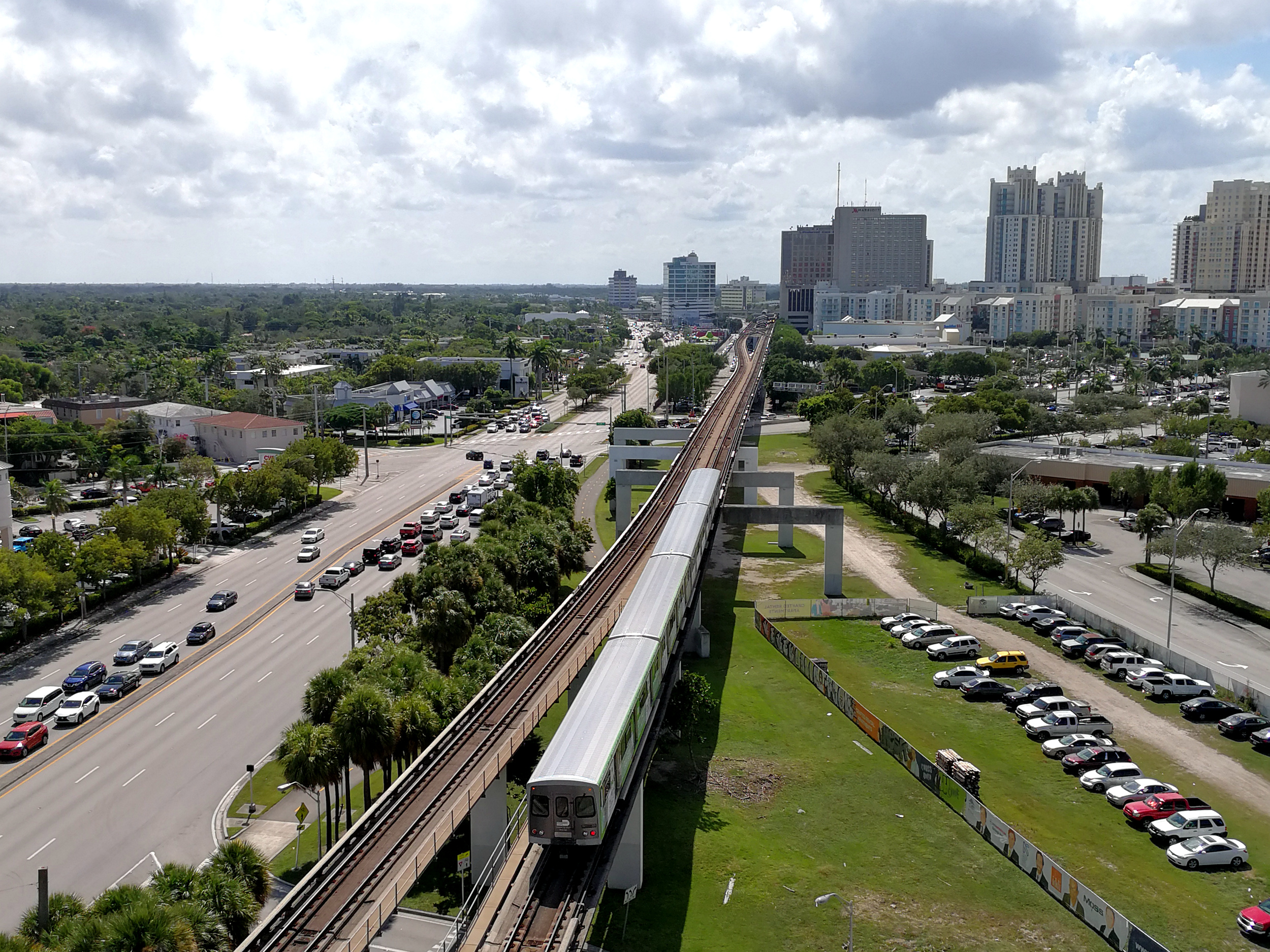
Miami-Dade's South Dade Bus Rapid Transit (BRT) line grew ridership 22% in its first six months of operation while the county's three legacy transit systems all lost passengers year over year, according to data from the Miami-Dade Department of Transportation and Public Works.
The $368 million BRT line carried 154,190 passengers in April, up from 126,576 in its opening month of November 2025. The line gained riders every month except one.
The rest of the system moved in the opposite direction. Metrorail ridership fell 1.1% year over year in April. Metrobus ridership dropped 0.8%, extending a decline that has persisted every month since October 2024. Metromover took the steepest hit, down 4.6%. Overall, the county's transit network shed 0.9% of its passenger traffic compared with a year earlier.
The BRT terminates at Dadeland South, a transfer point for Orange Line riders from Coconut Grove and Brickell. The divergence between growing BRT ridership and shrinking Metrorail numbers at the same hub is visible in the county data, though no official has commented on what it means for service levels on connecting routes.
How the BRT cuts trip times with signal priority at rush hour
The BRT runs 60-foot electric buses along a dedicated busway from Florida City to Dadeland South, stopping at 14 stations. During rush hours, buses preempt traffic signals heading northbound in the morning and southbound in the evening, cutting the end-to-end trip to about 58 minutes. Without signal priority, the same ride takes roughly 68 minutes.
A park-and-ride lot opened at the 168th Street station in April, with parking on an upper level and passengers descending to the bus platform below.
The signal preemption has drawn complaints. Some South Dade residents and county commissioners say the system backs up east-west auto traffic at intersections during peak hours.
BRT's lower cost per trip reshapes debate over next transit corridor
The BRT's performance is feeding a broader argument about where the county should spend transit dollars next. A proposed North Corridor heavy rail extension to the Broward County line would cost $54 per trip — well above the $35 federal threshold for cost-effectiveness — and 23 times as much per mile to build as the South Dade BRT, according to a Florida Department of Transportation (FDOT) analysis.
"The resolution calls for all options. So it could be heavy rail. It could be light rail. It could be a streetcar. There's a universe of possibilities that we have to look at now," Nilia Cartaya, modal development administrator for FDOT, told the Citizens' Independent Transportation Trust.
The North Corridor study has no deadline for completion, and the state must still find funding to begin it.
County commission to weigh $350 million transit bond July 21
The Miami-Dade Board of County Commissioners is scheduled to meet Tuesday, July 21, for a second reading and public hearing on up to $350 million in Transit System Sales Surtax Revenue Bonds. Residents can attend or submit written comments ahead of the hearing.





.jpg)