
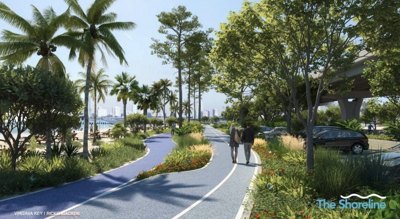
The architects and engineers studying whether the Rickenbacker Causeway can be rebuilt as a split-level highway with expanded beaches will present their latest findings to residents at a public open house Wednesday from 6:30 to 8:30 p.m. at Gramps Getaway on Rickenbacker Causeway in Key Biscayne. Attendees are asked to RSVP at rickenbackercorridor.org.
For Key Biscayne residents, the causeway isn't just a road. It's the only way on and off the island, carrying an estimated 28,000 vehicles daily, according to the project team's corridor assessment, and serving as the sole evacuation route during hurricanes.
The concept known as "The Shoreline" envisions a viaduct along the Virginia Key stretch of the corridor. High-speed through traffic would ride an elevated deck at 45 mph, while a lower level would carry four lanes of 30-mph local traffic with roundabout access to Virginia Key destinations including Miami Marine Stadium, the rebuilt Miami Seaquarium site and MAST Academy. The viaduct ramps would begin near the Rusty Pelican Marina entrance and end at Bear Cut Bridge.
The project would also convert roughly 28 acres into trail and beach space, up from the current 11 acres between the William Powell Bridge and the Seaquarium, according to Plusurbia Design's presentation at an earlier public workshop.
County has yet to approve the plan
The Shoreline has not been adopted or approved by Miami-Dade County, which owns and operates the causeway. The current work is a feasibility assessment, described by Miami-Dade Commissioner Raquel Regalado as "a stress test of this idea" at a previous public workshop.
Regalado, who represents District 7, has championed the concept since introducing it in 2025. The Key Biscayne Village Council voted 7-0 in late 2025 to move up to $950,000 from reserves into the Capital Improvements Fund to finance a seven-step feasibility analysis. That funding includes $260,000 for a feasibility report covering cost implications and project risks, and $300,000 for an updated concept plan with engineering, landscaping and mobility strategy.
Four organizations share the workload
Friends of The Underline, led by Chief Executive Officer Eulois Cleckley, is managing the feasibility assessment. Plusurbia Design, with principal Juan Mullerat, handles planning and architecture. HDR Engineering, led by Javier Manso, is running the technical and transportation analysis. The Key Biscayne Community Foundation, under Executive Director Melissa M. White, is leading community engagement.
"We should be wrapping up this study by late fall," Cleckley said at a previous public meeting. "We're on track."
Village Manager Steve Williamson and Village Planner Jeremy Calleros-Gauger represent Key Biscayne on the feasibility team.
A sewer line and protected trees limit the design
HDR's Manso has noted that a 102-inch sewer line running parallel to the causeway cannot be relocated, which limits where viaduct columns can be placed. Petrified groves near Crandon Park are a designated no-touch zone, restricting how far north bridge structures can extend.
The project team has compared the Shoreline to similar infrastructure projects and estimates a roughly 10-year timeline from the 2025 introductory concept to completion, assuming it advances past the feasibility stage.
How residents can share their input
Wednesday's open house is free. Residents can register and find more information at rickenbackercorridor.org or email [email protected]. Questions can also be sent to Regalado's office at [email protected].
The feasibility study is expected to conclude by late fall 2026.




.jpg)