
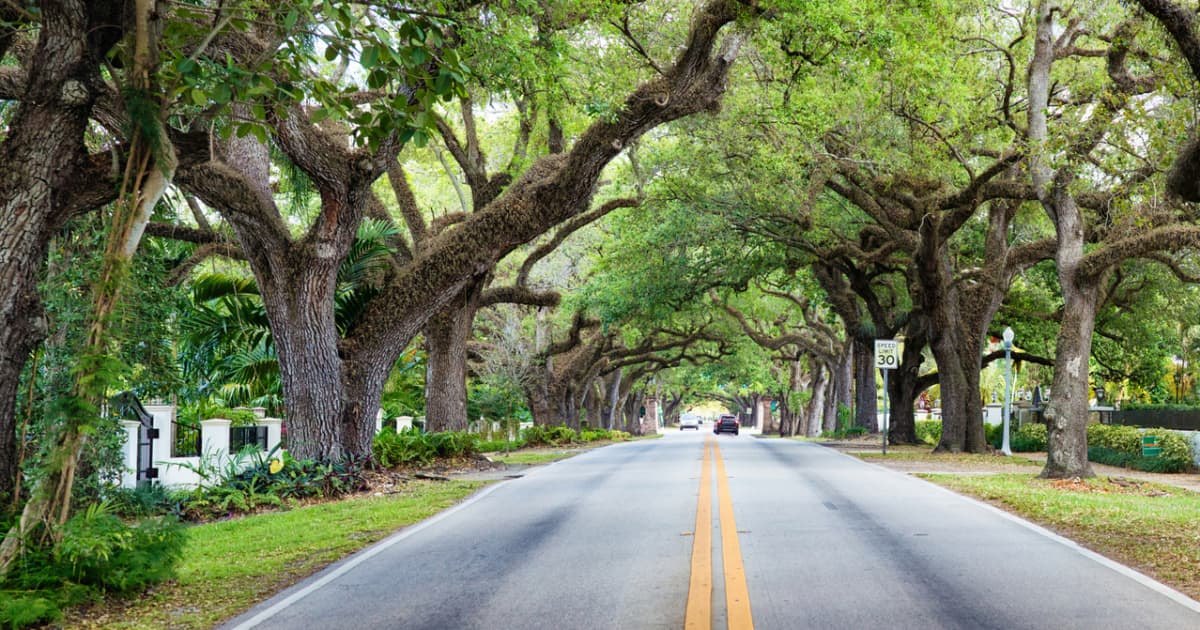
Trees can cool Miami-Dade neighborhoods by as much as 10 degrees Fahrenheit, but only if the right species grow in the right places, according to a multiyear Florida International University study published Aug. 14.
The findings land six days before Coconut Grove residents can weigh in on the city's tree ordinance rewrite at a public workshop on Aug. 20, from 6 to 9 p.m. at The Hangar at Regatta Grove, 3385 Pan American Drive.
Lead researcher Christopher Baraloto, director of the International Center for Tropical Botany at the Kampong, was recently appointed to the City of Miami's Tree Ordinance Advisory Committee. That panel is expected to recommend changes to the city's tree permitting process in early 2027.
Why species selection matters more than tree count
Baraloto's team at FIU's Institute of Environment drew on more than two years of temperature monitoring, inventories of more than 9,000 urban trees, countywide canopy analyses and a survey of 600 residents, according to FIU's newsroom.
Not all trees cool equally. Trees with large, dense canopies, like native fig, produce the most cooling. Palms and ornamental trees such as royal poinciana deliver far less. And young trees cannot match what a mature canopy provides, according to Madison Kinder, an urban ecology fellow in the Institute of Environment.
Baraloto led a separate inventory of Coconut Grove's street trees and found high species diversity, but much of it comes from palms that contribute limited canopy. A smaller number of large native trees, including live oak and gumbo limbo, account for a disproportionate share of street-level shade. Baraloto said protecting those existing large trees and selecting species capable of developing substantial crowns could matter as much as increasing the number of trees planted.
Miami-Dade's canopy still falls short of its own goal
Miami-Dade County has about 20% tree canopy coverage, according to 2022 data from FIU's Geographic Information Systems Center. County officials have set a goal of 30%.
Jennifer Fu, director of the FIU Coastal Environmental Data and GIS Center, said the county urgently needs an updated canopy assessment to understand where and how the tree-scape is changing.
Paulo Olivas, an assistant professor of Earth and Environment at FIU, said the benefits depend on what gets planted, how large the trees become, where they grow and whether mature canopy is protected.
The study lands amid a surge in tree-removal fights
The research arrives as Coconut Grove faces a wave of tree-removal pressure. The city's Historic and Environmental Preservation Board has handled at least 14 tree-removal appeals since January, compared with one in all of 2025. The board held an eight-hour hearing on eight appeals before a standing-room-only crowd of more than 100 people on July 22-23, as we reported Aug. 7.
Separately, the Allen Morris Company has filed permits to remove more than 40 trees from the Ziggurat development site at 3103 Grand Ave., the Miami Herald reported. Coconut Grove resident Kat Morris told the Herald she feels developers are "strip-mining our city."
Baraloto said he hopes his committee appointment will help shape mitigation policy that balances development with canopy preservation.
"Miami's urban forest is already doing important work protecting residents from extreme heat, but what we need now are mitigation requirements that better reflect what is being lost, smarter species selection and targeted investment in neighborhoods that need shade the most," he said.
How residents can weigh in on the Aug. 20 workshop
The District 2 workshop is one of five the city is hosting across all commission districts in August. Residents can attend the Coconut Grove session on Aug. 20 at The Hangar at Regatta Grove, 3385 Pan American Drive, from 6 to 9 p.m. For more information, call 305-416-1100 or visit miami.gov.


.jpg)