
Key Biscayne stands to lose up to $1.6 million in annual property tax revenue if Florida voters approve Amendment 3 in November, according to Village Chief Financial Officer Benjamin Nussbaum.
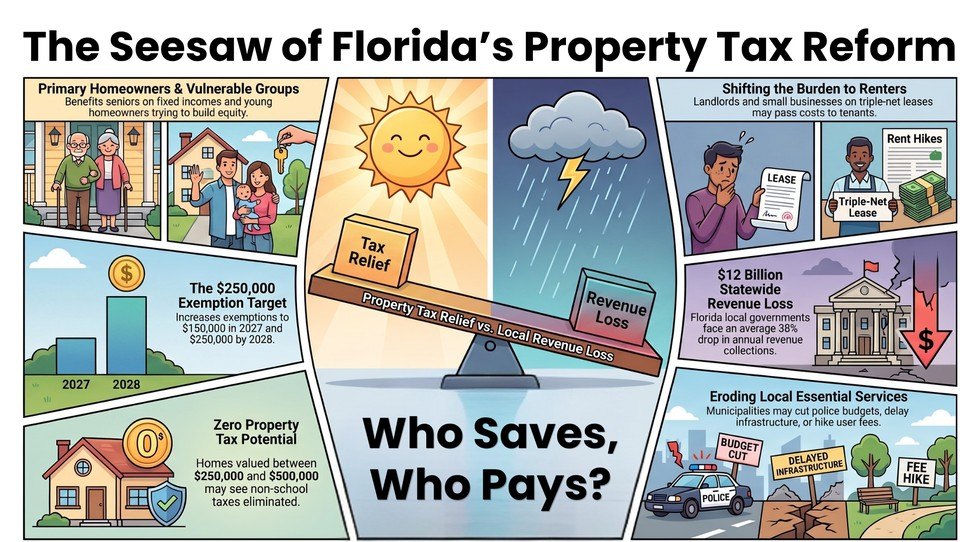
The proposed constitutional amendment, on the Nov. 3 ballot, would triple the homestead property tax exemption from $50,000 to $250,000 by January 2028. For a community where 72% of revenue comes from property taxes, the math is stark.
Nussbaum told the Islander News that the village's 2,777 homesteaded properties — 37.5% of the island's 7,395 parcels — would generate roughly $800,000 less in tax revenue in 2027 under a $150,000 exemption, and $1.6 million less in 2028 when the full $250,000 exemption takes effect. Those estimates don't account for a second provision that would cut the annual assessment cap on non-homesteaded properties from 10% to 5%.
Budget Timeline Puts Village on a Collision Course With the Ballot Measure
The timing collides with the village's budget cycle. The council gave nonbinding consensus approval at a June 30 budget workshop to Village Manager Steve Williamson's proposed fiscal year 2027 budget, which includes a $44.4 million operating budget and $64.1 million in capital spending across 34 projects. The fiscal year begins Oct. 1.
Williamson said staff is developing a phased approach to absorb potential tax cuts and that the fiscal 2027 budget has enough room to cover the first-year $800,000 loss if the amendment passes.
"It's a prudent financial exercise to ensure that we're not imposing a tremendous impact later on to the residents," council member Fernando Vazquez said at the workshop.
Statewide Losses Could Top $12 Billion, With Miami-Dade Hit Hardest
The Florida Policy Institute reported June 18 that Amendment 3 could reduce local property tax collections statewide by $12 billion annually, roughly 38% of current revenue for counties, municipalities and special districts. Miami-Dade County alone would face a recurring loss of at least $1.41 billion, the largest of any Florida county.
Key Biscayne levied $33.8 million in property taxes in fiscal year 2025-26, according to Florida Department of Revenue figures. The village's draft fiscal 2027 budget proposes raising the millage rate from 2.885 to 3.006 mills, a 4.2% increase. But on July 2, Miami-Dade County reported the island's tax base grew 5.1% to $12.3 billion, 21% more than originally projected.
"With the new number, we won't need all the new revenue," Nussbaum said at the budget workshop.
Former Mayor Sues Over Ballot Language Ahead of a July 29 Hearing
Former Key Biscayne Mayor Mike Davey isn't waiting for Election Day. Davey is a lead plaintiff in a lawsuit challenging Amendment 3's ballot language as inaccurate and misleading. A hearing is set for July 29 in Leon County.
"A lot of people, including the elderly, are going to be hurt when services get cut," Davey said. "Nobody wants to pay more taxes than they have to, but there has to be a better way to approach this."
Even if the lawsuit succeeds, the remedy under current state law would be for the attorney general's office to rewrite the ballot language. The referendum itself would likely still proceed.
New State Law Raises the Bar for Any Future Tax Rate Increases
Gov. Ron DeSantis signed Senate Bill 4-F on June 24, requiring a supermajority vote from any municipality or county board to raise property taxes beyond the rollback rate. Increasing the rate up to 110% of rollback requires a two-thirds majority; going higher requires a three-quarters vote, a unanimous vote or a voter referendum.
That means if Amendment 3 passes and Key Biscayne needs to raise rates to compensate, the council faces a higher procedural bar to do so.
The council discussed alternative revenue sources at the workshop, including raising stormwater and Community Center fees. Police services account for $12.2 million of the operating budget and fire rescue $11.4 million.
Amendment Faces Narrow Odds, With Public Budget Hearings Ahead
Amendment 3 requires 60% voter approval to take effect. An April poll by MDW and Miami-based Edge Communications found just 55.1% of respondents supported the measure, below the passage threshold, with 14.4% undecided.
The village's next community budget meeting is Aug. 12. Miami-Dade County will mail TRIM notices in August. Formal budget hearings are scheduled for fall 2026. Residents can attend council meetings at Village Hall or submit comments through the village clerk's office.






.jpg)